(July, 28, 1947, Paris, France)
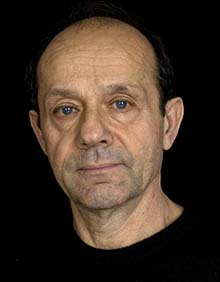 Georges Rousse he is a French photographic plastic artist.
As a medical student in Nice, Georges Rousse decided to learn shooting and printing techniques from a professional, and then create his own architectural photography studio. His passion drives him to dedicate himself completely to an artistic practice of this medium, following in the footsteps of the great American masters of landscape and architectural photography such as Edward Steichen, Alfred Stieglitz or Ansel Adams.
Discover the Land art artists, who combine ephemeral plastic interventions in the natural space of the landscape and narrated by the photographic view, testimony of this intervention and then decide to intervene plastically in the photographic space correctly. said not in the image but in reality directly; thus establishing a relationship between painting and “space”. To be able to draw in space, the need for photography as a declaration of an artistic action in space implies the practice of anamorphosis, an image distortion technique invented by Piero de la Francesca during his research on spatial perspective.
At the heart of the questioning of the nature of the work of art, his work refers fundamentally to our relationship with space and time, concepts transmitted by his means of creation: photography.
Its main material is space. The second is Photography.
From the beginning of his work, he takes care of abandoned places, which he has always loved (baby boom, grew up in ruins, dating from the Second World War), to transform them into pictorial space (the study of his artist) and build a unique work of short duration there, which only restores the photograph, in a final work. From the vision of the objective, he builds in these places of emptiness a utopian work, projecting his vision of the world, his mental “universe” there, crossing plastic concerns in resonance with the place, its history, the culture of the Country where it operates. The work in situ, created for and in the place, the resulting photographs are carriers of the memory of the place where he intervened, his past represented by the state of abandonment and highlighted by the artist’s plastic intervention, but also of the memory of the artist’s gesture.
Georges Rousse also highlights the problematic relationship, in industrialized societies, of man with his trace, architectural among others, with his memory and, therefore, with time. These precarious, rejected, ignored, often degraded places, whose disappearance is near, are like a metaphor for Time’s fierce flow towards oblivion and death. By sublimating these spaces, he wants to demonstrate that it is always possible to restore them, transform them to another place, extend his life, through the photographic trail. And more, to give them another dynamic.
With photography, Georges Rousse forces us to a static reading of architectures, to an immobile investigation of the Image, which little by little transforms our perception of Space and Reality. Our certainties and perceptual habits are disturbed by the meeting in the final image of three spaces: the real space in which the artist intervenes and the fictitious and utopian space that he imagines and then patiently builds on the place, superimposes a new space that only It occurs at the time of shooting and only exists through the mediation of photography. Beyond a simple visual game, this enigmatic fusion of spaces in the image dazzles the question of the reproduction of reality through photography, of the gap between perception and reality, between imagination and reality.
Because photography, the purpose of pictorial action, is a flat surface, the forms that he paints or draws, the volumes and architectures that he builds are divided, broken down, into the different spatial planes of the sometimes monumental buildings Photography brings the Image together in a masterful synthesis where Painting, Architecture, Drawing are inscribed in Space to make the artist’s fiction visible.
“She (photography) enhances the place. Eliminates the most unpleasant elements. Bad odors, misery, swarms of rats. So we have a space that, ultimately, is in its most total seduction. A seduction that the installation tends to increase as well. Therefore, my photography tries to give the best of architecture at any given moment. And everything that is experienced, every day, the human being disappears “
To allow viewers to share their experience of the space, he presented his images in large-format prints from the early 1980s. This strong and unique work that moves the boundaries between traditional media has immediately established itself in the contemporary art scene.
The work of Georges Rousse has certainly evolved considerably, but it is a gradual evolution, within a working protocol that has remained constant: only one medium: photography; the same type of place: abandoned buildings or buildings awaiting work in which the artist intervenes by drawing or painting; a photograph of this intervention designed from the camera’s particular point of view, showing how she comments on or transforms the existing architecture.
The entire work process of Georges Rousse was gradually implemented, increasing throughout his research to occupy the space “otherwise”. Their work is fueled by context, meetings, and resources. In this sense, it is not a conceptual work.
His work
The anamorphosis
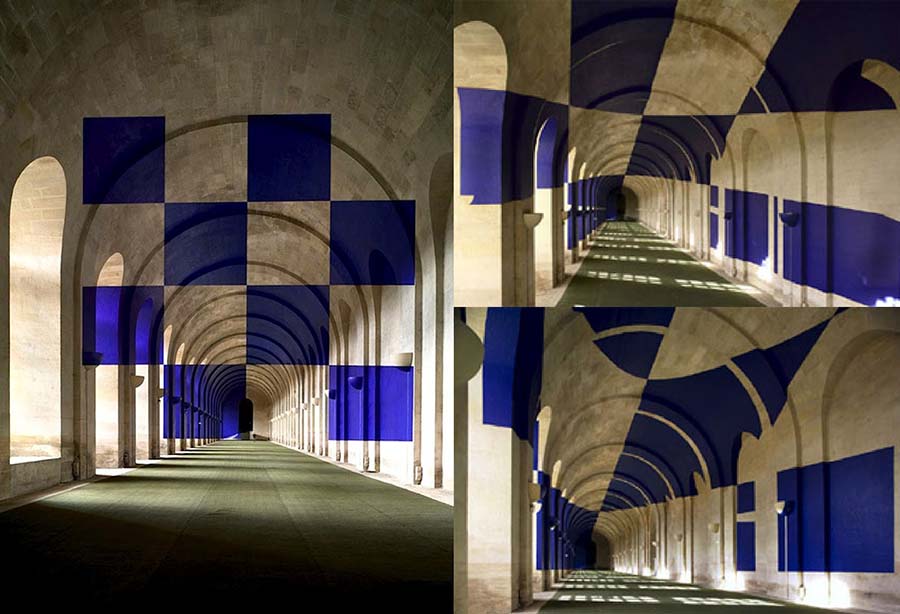
The principle of anamorphosis is defined as a mode of explosion in space. The painted elements (figures, intangible sculptures, etc.) can only be restored visually if we look at them from a certain point of view, in which the artist sets his eye on his camera. If you change a little, you no longer perceive the same at all.
Throughout his work, Georges Rousse has used this principle enormously, which he himself defines as a “tool”.
“The anamorphosis is nothing more than a tool, like the brush when I draw a shape or the architecture when I build or break a wall. It is only a visual tool. I like my camera. So, for me, there is a conjunction in the use of anamorphosis and photography. When you look at my photos, there is no anamorphic effect. The image we see there, however, comes from the anamorphosis process. “
The photograph that the artist gives to see shows the image of an anamorphosis, but it is not an anamorphosis in itself. It is a sculpture, a pyramidal volume, for example, or a table, as there is in the chessboard series. The objective is to introduce a perspective and a pictorial action within a space that is photography. When we understand that your images are not included in the copy / paste technique, we can try to deconstruct what is in front of us. There is a whole possible static path to take in front of the image: we follow a line, we see that it starts from the ground, goes through the wall, slides in a corner, returns to the front, goes to the ceiling to descend, etc. There is anamorphosis but static, immobile.
Figuration
In the early 1980s, his work manifested itself through a series of photographs demanding a form of “free figuration”. In fact, the artist intervenes in abandoned places, destined to be demolished, where he paints human figures.
Then, starting in 1983, he became more interested in the space and the design of the plans to invest: the characters were painted on different walls (in small pieces) and only photography reconstituted the unit by adopted points of view.
For the artist, it is a way of rejecting the photo by introducing painted characters on all kinds of supports (especially on the walls of abandoned places). So painting seems so “superior” to photography in terms of its usability. At this point, the artist realizes that in his work, painting is just a simple “medium”. Its support is the wall.
The experience of the relationship between the painted figure and space, after this relationship of the photo with the painted subject, constituted only one phase in his work. From then on, the artist reconsidered his relationship with space and left figuration and became interested in geometric volumes, which he called “intangible sculptures”.
Intangible sculptures
These intangible sculptures are visible, recognizable figures, whose material and texture are understood, but which are elusive in their physical reality because they are only drawing.
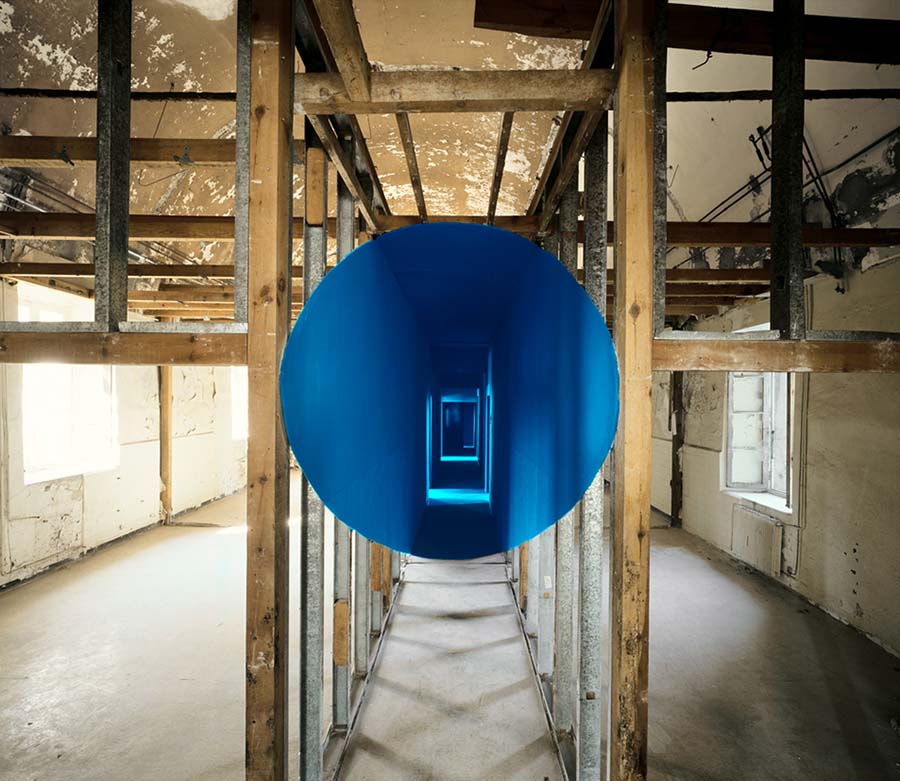
After the figurative sequence, Georges Rousse asked himself the question of how to introduce sculptures into space. Should I build them, but what would they become? Should I suggest them, but how? After going through different stages, he made a decisive experience during a trip to Calcutta. Due to poverty and the multiplication of large families, the city is made up of buildings that are developed according to an empirical external growth system that meets the needs of living space. In the same way, the artist imagines putting volumes in his work, but in a virtual way, painting them in space like the previous figures. Then, little by little, he comes up with the idea of building his own growths and that leads him a little later to a complete series of photos that present the interior of the circles with oblique, smooth shapes, etc.
Words
During the work of preparing his works, Georges Rousse takes all kinds of notes about painting, art, loneliness, death, which lead to notebooks. Then he came up with the idea of expressing his relationship with space, no longer creating any figure there but transferring these texts to somewhere in the same place.
Being also a great lover of poetry and literature (André du Bouchet, Philippe Jaccottet), Georges Rousse seeks to know how to deal with space to produce something similar to what he experiences in reading the texts of these authors. That is, how to restore this spatial relationship of words to the blank of the sheet.
For these works use words from the Greek, like “Gaïa” or “Eros”, English, like “light”, and French like “eau”. Words are for him a new way of inhabiting space, through poetry.
Doors
From 1985 to 1987, Georges Rousse was a guest as a painter at Villa Medici in Rome. On this occasion, a series entitled “Embrasures” begins, which translates into work on light and architecture, a play on colors, a play on words between the doors of these abandoned places and the conflagration. represented by the color red.
“These are places of incandescence and regeneration of the sun, all the interior that I painted in cinnabar red to symbolize fire”.
Maps/Plans
Son of a soldier, Georges Rousse traveled a lot during his childhood and throughout his life; either for these different facilities or exhibitions (France, Europe, United States) or for these personal trips (trekking in Nepal). For him, artistic creation and travel are two totally interdependent dimensions of his life that feed each other.
“I travel to create, as much as I create to travel”
Create a series by superimposing the view of space with a reproduction of topographic maps of Nepal. Through this work, the artist questions the notion of memory, the use of the map has moved from a memory of crossed landscapes to a memory of history itself. In addition, some works in this series are a form of protest and commitment of the artist. For example, he drew up the plan for the city of Hiroshima in 1940 in a house belonging to the imperial family. Therefore, the work is situated between the memory of history and a protest against nuclear energy.
Collections
Since his first exhibition in Paris, at the Galerie de France in 1981, Georges Rousse has continued to exhibit and work around the world, in Europe, in Asia (Japan, Korea, China, Nepal.), in the The United States, in Quebec, in Latin America …, following their artistic path beyond fashion.
Awards
- 1983 : Villa Médicis « hors les murs » à New York
- 1985 – 1987 : Villa Médicis, Rome
- 1988 : Prix ICP (International Center of Photography), New York
- 1989 : Prix de Dessin du Salon de Montrouge
- 1992 : Bourse Romain Rolland à Calcutta
- 1993 : Grand Prix National de la Photographie
- 2008 : Georges Rousse succède à Sol Lewitt comme Membre associé de l’Académie Royale de Belgique
Shooting techniques
Use a camera (large format camera) and work on movies with 4×5 inch film shots and a wide angle lens.
The camera replaces the artist’s eye due to the use of a lens that distorts space. When doing work, Rousse places a layer on the frosted glass of the lens with the contour outline of what he wants to achieve, allowing him to verify that the desired pattern matches the contour made in real space. He reports the motif in this space with the help of your assistants.
It also uses Polaroid films to store workspace and smaller format film systems (Leica R film 24×36 and 28mm lens with digital / shift SLR) to “take notes”.
Draw
Rousse’s works are drawn in large format, their smallest dimension is usually 125 cm. Most of the prints are 160 cm × 125 cm, some works are narrower or square.
Until 2000, prints were made at Cibachrome. For a few years now, the prints have been Lambda digital prints. Prints are laminated to Dibond aluminum. A work thus edited can be protected by Diasec (en) or framed (for example, with an American box). A work is drawn in five copies before it is considered out of print and can therefore no longer be sold.
Some of his Photos



You might also like