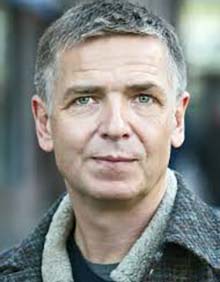
Andreas Gursky (January 1955, Germany) is a German photographer and also a professor at the Kunstakademie Düsseldorf in Germany. It is known for its large format architecture and landscape color photographs, often employing a very high point of view. Gursky shares a studio with Laurenz Berges, Thomas Ruff and Axel Hütte at the Hansaallee in Düsseldorf. The building, an old electricity station, was transformed into a study of artists and living rooms, in 2001, by the architects Herzog & de Meuron, of Tate Modern fame. In 2010-2011, the architects worked again in the building, designing a gallery in the basement.
Gursky did not digitally manipulate his images until the 90s. Since then he has been very sincere about his use of computers to correct and enhance his paintings, creating an art of spaces larger than the subjects photographed. Art critic Peter Schjeldahl described these images as “vast”, “splashy”, “entertaining” and “literally incredible” in the magazine “The Newyorker“. In the same publication, the critic Calvin Tomkins described Gursky as one of the “two masters” School “Düsseldorf”.
In 2001, Tomkins described the experience of facing one of Gursky’s great works:
The first time I saw the photographs of Andreas Gursky I had the disorienting feeling that something was happening, happening to me, I suppose, although it felt more generalized than that. The immense and panoramic color prints of Gursky, some up to six feet high by ten feet long, had the presence, the formal power and in several cases the majestic aura of nineteenth-century landscapes, without losing any of their meticulously Detailed immediacy As photographs. His theme was the contemporary world, seen dispassionately and at a distance.
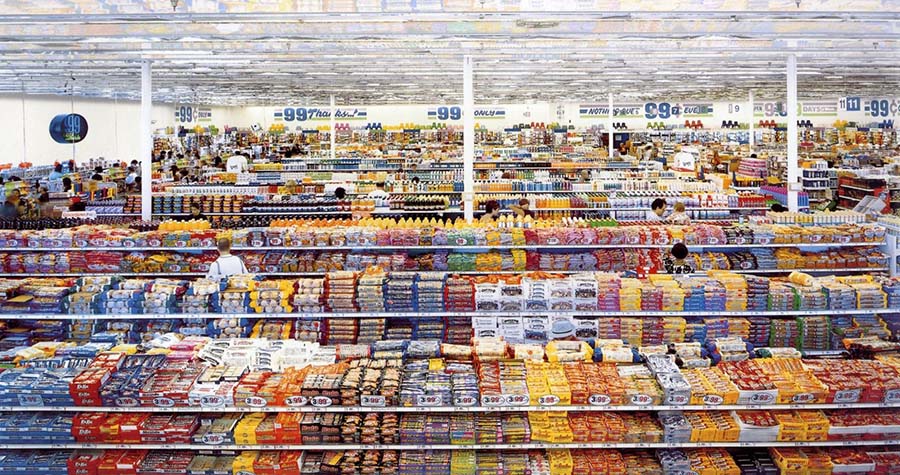
The perspective in many of Gursky’s photographs is drawn from a high point of view. This position allows the viewer to find scenes that encompass both the center and the periphery, which are ordinarily out of reach. This broad perspective has been linked to a commitment to globalization. Gursky is attracted by the large anonymous, man-made spaces, the facades of the night, the office lobbies, the stock exchanges, the interiors of the big retailers of the box (see his print 99 Cent II Diptychon). In a 2001 retrospective, the Museum of Modern Art in New York described the artist’s work as “a sophisticated art of disengaged observation, thanks to the ingenuity of Gursky’s fictions, that we recognize his world as ours”. Gursky’s style is enigmatic AND dead. There is little or no explanation or manipulation in the works. Your photography is simple.
The photograph of the Gursky Dance Valley Festival, taken near Amsterdam in 1995, depicts attendees facing a DJ stand in a large arena, under the effects of strobe lighting. The smoke that spills resembles a human hand, holding the crowd in ecstasy. After completing the printing, Gursky explained that the only music he now listens to is the anonymous, beat-heavy style known as Trance, since its symmetry and simplicity echoes his own work, playing towards a deeper and more visceral emotion.
The 99 Cent photograph (1999) was taken at a 99 cents store only on Sunset Boulevard in Los Angeles, and depicts its interior as a stretched horizontal composition of parallel shelves, intercepted by vertical white columns, at The abundance of “They are transformed into fields of color, generated by innumerable arrangements of identical products, which are reflected in the bright ceiling” (Wyatt Mason). The Rhine II (1999), represents a section of the Rhine River outside Düsseldorf, immediately readable In its six-part series Ocean I-VI (2009-2010), Gursky used high-definition satellite photographs that he increased from several sources of image On the Internet.
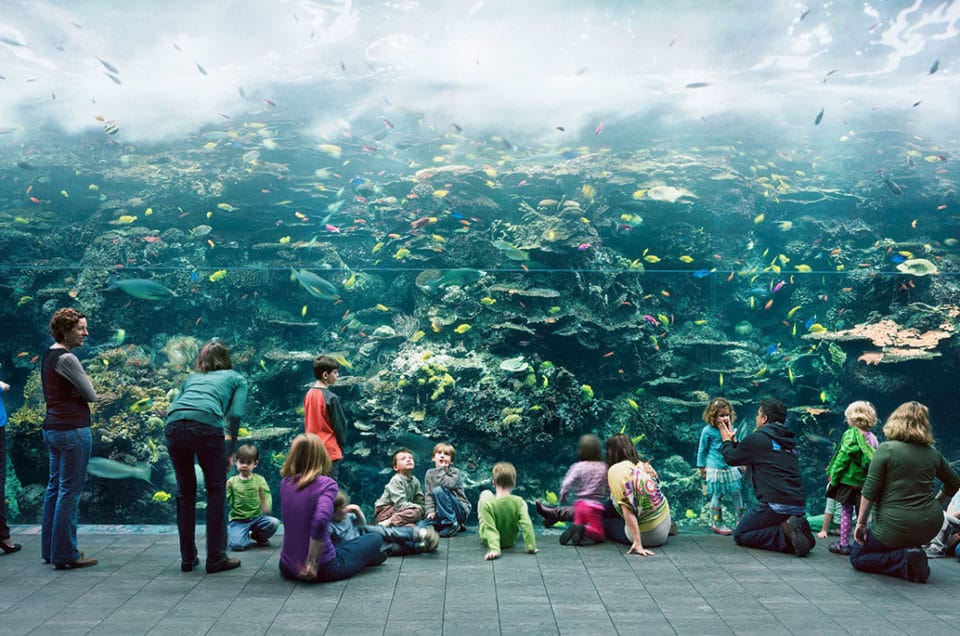
Some of his photos:


You might also like