(1923, NYC, USA – 2013, NYC, USA)
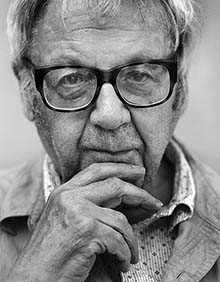 Saul Leiter (born 1923) is an American photographer and painter whose early work in the 1940s and 1950s was an important contribution to what came to be recognized as The New York School.
Leiter began his life as a painter but has made an enormous and unique contribution to photography. His abstracted forms and radically innovative compositions have a painterly quality that stands out among the work of his New York School contemporaries. Perhaps this is because Leiter has continued through the years to work as both a photographer and painter.
Leiter was born in Pittsburgh, Pennsylvania. His father was a well known Talmud scholar and Saul studied to become a Rabbi. His mother gave him his first camera at age 12. At age 23, he left theology school and moved to New York City to become an artist. He had developed an early interest in painting and was fortunate to meet the Abstract Expressionist painter Richard Pousette-Dart.
Pousette-Dart and W. Eugene Smith encouraged Leiter to pursue photography and he was soon taking black and white pictures with a 35 mm Leica, which he acquired for a few Eugene Smith prints. In 1948, he started taking color photographs. He began associating with other contemporary photographers such as Robert Frank and Diane Arbus and helped form what Jane Livingstonhas termed the New York School of photographers during the 1940s and 1950s.
Leiter worked as a fashion photographer for the next 20 years and was published in Show, Elle, British Vogue, Queen, and Nova. In the late 1950s the art director Henry Wolf published Leiter’s color fashion work in Esquire and later in Harper’s Bazaar.
Edward Steichen included Leiter’s black and white photographs in the exhibition Always the Young Stranger at the Museum of Modern Art in 1953. Leiter’s work is featured prominently in Jane Livingston’s book The New York School (1992) and in Martin Harrison’s Appearances: Fashion Photography since 1945 (1991). In 2008, The Foundation Henri Cartier-Bresson in Paris mounted Leiter’s first museum exhibition in Europe with an accompanying catalog.
Leiter is the subject of a 2012 feature-length documentary In No Great Hurry – 13 Lessons in Life with Saul Leiter, directed and produced by Tomas Leach. Leiter is a featured subject, among others, in the documentary film Tracing Outlines (2015) by 2nd State Productions.
Martin Harrison, editor and author of Saul Leiter Early Color (2006), writes, “Leiter’s sensibility placed him outside the visceral confrontations with urban anxiety associated with photographers such as Robert Frank or William Klein. Instead, for him the camera provided an alternate way of seeing, of framing events and interpreting reality. He sought out moments of quiet humanity in the Manhattan maelstrom, forging a unique urban pastoral from the most unlikely of circumstances.”
Leiter died on 26 November 2013 in New York City. He is represented in New York by the Howard Greenberg Gallery.
Publications
- Early Color. Introduction by Martin Harrison.
- Göttingen: Steidl, 2006. ISBN 978-3865211392.
- Paris: Delpire, 2007. Photo Poche series.
- London: Thames and Hudson, 2008. ISBN 978-0500410974. Photofile series.
- Early Black and White.Göttingen: Steidl, 2008.
- Göttingen: Steidl; Howard Greenberg Gallery, 2014. ISBN 978-3865214133. Two volumes, boxed edition.
- Saul Leiter. Göttingen: Steidl, 2008. ISBN 9783865216625. Preface by Agnès Sire.
- Photographs and Works on Paper. Antwerp: Fifty One Publication, 2011. ISBN 9789081772501. Exhibition Catalogue.
- Here’s more, why not?. Antwerp: Fifty One Publication, 2013. ISBN 978-9081772518.
- Painted Nudes. London: Sylph, 2015. ISBN 978-1909631069.
- All About Saul Leiter. Seigensha, 2017.
- Women. Tokyo: Space Shower, 2018. ISBN 9784909087157. Mostly photographs, some paintings.
Some of his photos:


You might also like