(october, 22 Budapest, Hungary – May 25, 1954, Thai Binh, Vietnam)
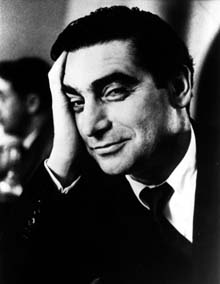 Robert Capa (Ernö Friedmann) was born in Budapest, into a Jewish family with a good financial outlook. Her mother a fashion designer and her father an intellectual thinker with aristocratic influences.
In Hungary, at that time, it was customary to belong to a circle, be it artistic or political, and Endré, who was not an exception, entered these circles, where it was tradition to put nicknames. This is how he received the nickname Bandi.
Condemned in his adolescence to live wandering around the city due to the establishment of his parents’ workshop at home, after they lost their premises due to the economic depression of 1929. In these adventures he would meet one of the women that most influenced his life, and it can be said that, if it had not been for her, he would not have become a great photographer. That woman’s name was Eva Besnyo, who from a very young age had a great interest in photography. Eva was one of those people who found it more productive to take pictures than to do their homework. In his youth he already took pictures with his Kodak Brownie camera. She and her special taste for this art motivated Endré’s first contact with photography. Endré was highly sought after by his friends, as he was characterized by being a generous and loyal young man with his friends.
Already towards his flourishing seventeen years and waiting to finish his school life, Endré meets one of those people who would shape his life, one of those good friends who set out on his paths, with excellent advice, timely financial support, appropriate connections, suggestions artistic and conceptions about life. This illustrious character was called Lajos Kassak, who, with socialist tendencies, decided to help any artist with constructivist tendencies. He made photography known as a social object showing the injustices of the capitalist system and presenting works in his seminars such as those of Jacob Riis and Lewis Hine.
In 1929 the political situation went from bad to worse with the imposition of a fascist government in Hungary, which forced young Endré to leave the country along with the great mass of young people who felt pressured by the lack of a democratic government and economic guarantees.
At 18 he left Hungary, then already under a fascist government. After spending time in Germany, he traveled to Paris, where he met photographer David Seymour who got him a job as a photojournalist in Regards magazine to cover the Popular Front mobilizations.
Between 1932 and 1936, trying to escape Nazism, Ernest Friedmann, living in France, meets the German photographer Gerda Taro (Gerda Pohorylle) who would end up being his girlfriend. To try to increase the price of the couple’s often rejected jobs, they invent the name of the American photographer Robert Capa, a pseudonym used interchangeably by both. This fact forms the basis of the controversy over which of the two actually took some of his most relevant photographs.
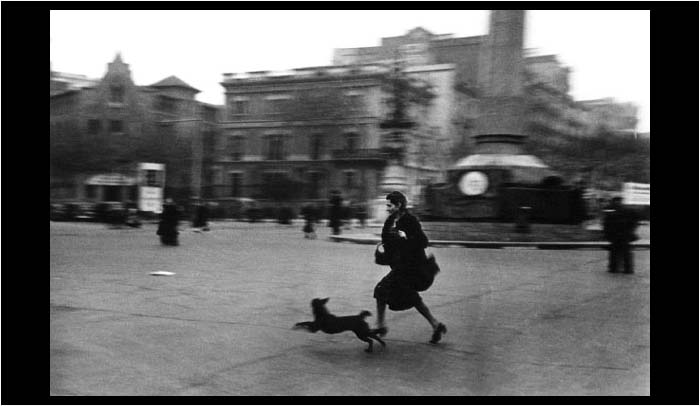
When the Spanish Civil War broke out in July 1936, Capa moved to Spain with his girlfriend to cover the main events of the Spanish war. Involved in the anti-fascist struggle and with the cause of the Republic, he was present, from that side, on the main combat fronts, from the beginnings on the Madrid front to the final withdrawal in Catalonia.
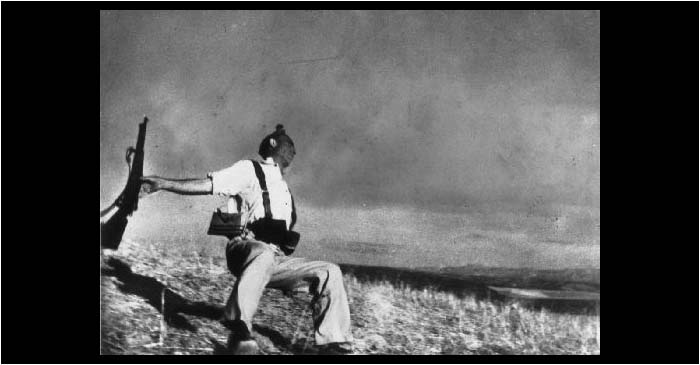
Always on the front line, his photograph Death of a Militiaman, taken in Cerro Muriano, on the Cordoba front, on September 5, 1936, is world-famous. Reproduced in most books on the Civil War, its authenticity It has been questioned by various experts. Despite the fact that a local historian from Alcoy named the militiaman, Federico Borrell García, an anarchist militiaman, the documentary La sombra del iceberg (2007) denies such attribution with witnesses, forensic doctors and documents from the Alcoy local archive. Likewise, it shows the inconsistency of said thesis and provides new photos of the militiaman sequence that support the thesis of the staging, as well as the possibility that the snapshot was not taken by Capa but by his wife. In January 2008, according to CNN, a suitcase lost by Capa was found where there are innumerable negatives of shots he made in the Spanish Civil War; a treasure of incalculable historical value. According to an article published on the El Periódico website, it is clear that said set of photographs were taken 10 kilometers from the front, in the town of Espejo, where the Republican troops had their headquarters at that time, according to the newspaper.
During the retreat of the republican army in the battle of Brunete, in July 1937 Gerda Taro died when braking the car in whose stirrup he traveled, falling and being run over by the tank that the driver tried to avoid. At this time, Capa also covered different episodes of the Japanese invasion of China, already in the prelude to World War II.
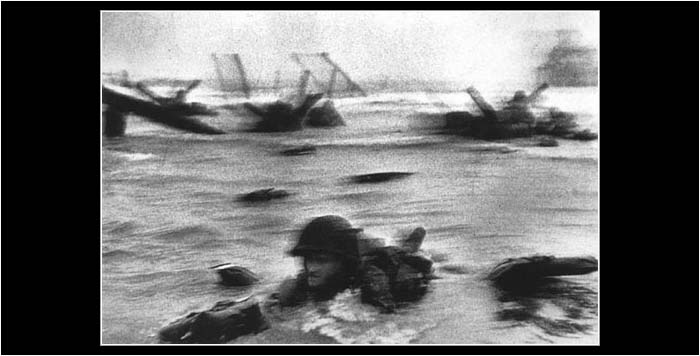
During the Second World War, he was present in the main war scenes of Europe, so from 1941 to 1945 he traveled through Italy, London and North Africa. From the Allied landing in Normandy, on June 6, 1944, the famous D-day, his photographs taken are classic, together with the soldiers who landed on the beach called Omaha in the terminology of the operation. He also captured the liberation of Paris in images. Huston Hu Riley was the photographer who portrayed that moment. For his work during this conflict, he was awarded by General Eisenhower with the Medal of Freedom.
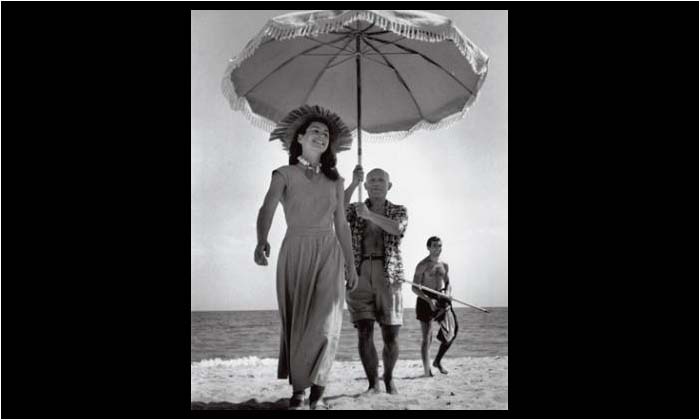
In 1947, together with the photographers Henri Cartier-Bresson, Rodger, Vandiver and David Seymour, he created the Magnum Photos agency, where Capa carried out a great photographic work, not only in war scenes but also in the artistic world, in the one with great friendships, including Pablo Picasso, Ernest Hemingway and John Steinbeck.
In 1954, while in Japan visiting friends from before the war, he was called by Life magazine to replace another photographer in Vietnam, during the First Indochina War. In the early hours of May 25, while accompanying a French army expedition through a thick wooded area, he inadvertently stepped on a mine and died, being the first American correspondent killed in this war and thus ending a hazardous professional life, guided by a phrase What popularized: If your photos are not good enough is that you have not gotten close enough.
Links
Some of his Photos

You might also like