(October 16, 1890, NYC, USA – March, 31, 1976, Orgeval, France)
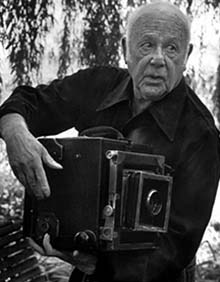 Paul Strand, of an immigrant family from Bohemia, (Czech Republic), was one of the forerunners of «direct photography» or «pure photography», together with Alfred Stieglitz and other photographers of the “Photo-Secession” and the “Gallery 291”, in addition from a reputed filmmaker.
Paul Strand began his career as a photographer at age 18 while a student at “Ethical Culture High School”. His devotion to photography was determined by his early association with Alfred Stieglitz and the photographers who exhibited at “Gallery 291”. In 1921 he also started making films, his films: “Mannahatta” from 1921, “Networks” from 1934, ” The Plow that broke the plans ”of 1935,“ Heart of Spain ”of 1940 and“ Native Land ”of 1942 are now recognized as film classics.
In 1945 the Museum of Modern Art dedicated his first solo exhibition to him as a photographer. Two years later he collaborates with Nancy Newhall on a project published as “Time in New England” Strand’s first groundbreaking photo book. This was the first in a series of books in which text and photographs interacted, became one, captured a place, its people, homes, landscapes. It was followed by “La France de Profil”, “Un Paese” in collaboration with the writer Cesare Zavattini, “Tir a´Mhurain”, “Living Egypt”, and “Ghana: An African Portrait”.
In 1967 Strand wins the “David Octavius Hill” award. In 1971, his most significant works were exhibited in the best museums in America and they toured Europe. His work is represented in museums and private collections around the world.
He died in Orgeval, France, on March 31, 1976 at the age of 85, that year he completed two original print portfolios: “On my Doorstep” and “The Garden”, published in 1976, and approved prints for two additional portfolios published below.
Start of your career
Strand was born in New York, his family name was originally “Stransky” which his father changed in 1890 after Paul’s birth to “Strand”. They lived in the western part of the city and Paul, his parents, Frances, his single aunt and his maternal grandmother lived in the house. His grandparents were those who emigrated from Bohemia, western Czech Republic, in 1840. His father was a seller of French kitchen utensils and his aunt Frances opened one of the first public nurseries in New York.
Jacob, Paul’s father gave him a “Brownie” camera when Paul turned 12, but at that time his hobbies then were skates and cycling, so he kept her away. In 1904, his parents – alarmed by the vandalism of many children from the Hell’s Kitchen public school – enrolled him with great difficulty for his economy, at the “Ethical Culture School” in West Central Park. One of the school’s teachers was Lewis Hine, a sociologist and photography enthusiast, whose portraits of children in factories contributed to improving child labor laws in the United States. Hine was then photographing the arrival of immigrants to Ellis island and following them through the slums where they ended up.
Hine decided to teach photography as an after-school activity, Strand and six other children signed up. They learned the basics of the camera, the darkroom, and the use of the magnesium dust flash for indoor photography. Hine took them to the “Gallery 291” of the Stieglitz group “Photo Secession” and there Strand discovered the work of David Octavius Hill, Robert Adamson, Julia Margaret Cameron, Gertrude Käsebier, among other artists, including Stieglitz himself. He decided with 17 years old, that he would also be a photographer. From that day he wanted to become a photography artist, he was no longer interested in going to school and started working as an office boy in his father’s firm. The firm was bought in 1911 by Another company and Paul decided to spend his savings on a trip to Europe.
For six weeks he traveled from country to country, Spain, Algeria, Monaco, Italy, Switzerland, France, Holland and England, visiting the major museums and monuments, and walking long distances. In Europe he photographed landscapes pictorially and with good compositions.
When he returned to the United States he accepted a job at an insurance firm, a few months later, in late 1911, he resigned and started a freelance business as a professional photographer, which did not succeed. But in 1912 he won the “New York Camera Club” award for “Temple of Love,” a photograph that showed Strand’s ability for this art.
From his classes with Hine, Strand spent most of his free time photographing, first with an 8×10 camera his uncle lent him, then with an Ensign Reflex, an English license plate camera he bought himself. He signed up in the “Camera Club of New York” which had a dark room and study. His mother believed that it was not a profession with a future but he had the full support of his father, who was also amazed when Paul took him to “Gallery 291” of the “Photo-Secession”.
Strand started doing portraits and traveling the country taking photos of schools and fraternities, photos that he later sold to students. This was done with his personal style. At that time the photographic style was that the images looked like paintings, photographs with diffused light and slightly out of focus. But Stieglitz started doing what would be called direct photography, this is images without manipulation or effects of any kind.
Strand took his photographs to “Gallery 291”, commonly called “291” and Stieglitz himself discussed his photographs with him. In “291” not only photographs were exhibited, but also works of plastic art from the European avant-garde : Picasso, Paul Cezanne, who fascinated young Strand.
In order to understand these painters, Strand took several abstract photographs, of which he said that he learned how to build an image, what an image consists of, how shapes are related to each other, how spaces are filled, how everything must have a certain Unit. Once he learned this, he no longer needed to work on pure abstraction, he simply applied what he had learned in photographs such as: “The White Fence, Port Kent, New York”, (The white fence), whose composition is born from the relationship between 9 brilliant posts of fence in the foreground and the dark barn behind them. “The White Gate” was taken in 1916, when he was in the city of Port Kent and can be said to contain the seed of Strand’s later work.
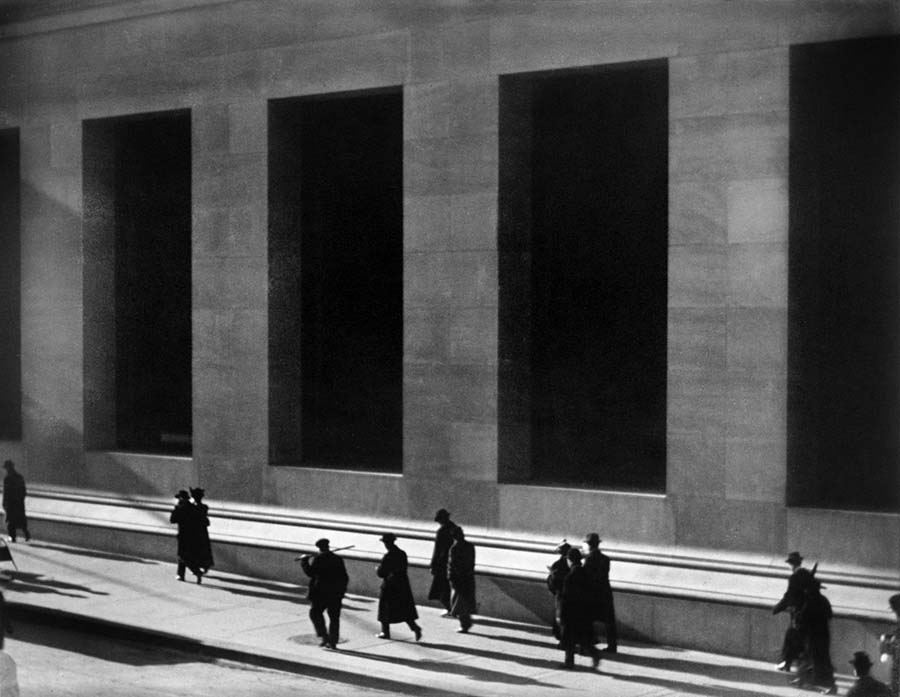
Strand began to take direct photographs, very different from the pictorialists of his time and with a very different subject matter as well. In New York he wanted to photograph the harsh city, according to him he had the idea of portraying people as they are seen in the parks of New York, sitting around, without posing, without even knowing that they are being photographed: he wanted to capture life everyday of ordinary people. To do this, he took the lenses from his uncle’s old camera and put them in his Ensign Reflex on one side, so these false lenses pointed in one direction and with the true ones he pointed out what he really wanted to photograph, without people knowing that he was being photographed. Many of his early portraits were made in this way.
Influences
For Paul Strand his teachers were, social reformers or revolutionary artists such as: Friedrich Froebel, Félix Adler, Lewis Hine, Alfred Stieglitz, Paul Cezanne, Picasso or Nietzsche. Froebel was the creator of the nursery, his influence on Strand came through the latter’s aunt, Frances, who as previously cited lived with him and was one of New York’s first nursery teachers. Froebel’s educational system was implanted in Strand through her aunt, manipulating basic shapes: cones, cubes, observation, play, and handling of objects and colors. One of the activities consisted of playing with wooden objects with geometric shapes so that the child could create symbolic worlds.
In his adolescence Strand studied at the “Ethical Culture Society”, founded by Félix Adler, who integrated morality, classicism and modernism, new and old, plastic and abstract into education, everything was integrated in a moral idea, to stimulate observation and imagination.
Hine was Strand’s photography teacher, teaching him that good photography is the result of intelligence and patience. Hine photographed the marginal society, the arrival of immigrants, working children and instilled this idea of social photography in Strand, who also photographed marginalized people, the poor. Hine took his students to the “Gallery 291” exhibition and taught them historical and industrial places in the city. He taught them the darkroom technique and took photographs for the school and for individual clients and businesses. He instilled photography in them. as something useful, practical.
After school Strand started working with his father and in his spare time taking pictures, he became a member of the “New York Camera Club” since he did not have access to the school’s darkroom then. There he learned the technique of bichromate gum and other techniques. From 1911 to 1914 Strand studied photography self-taught, seeing exhibits and taking photographs.
At the Armory Show exhibition Strand was impressed by post-impressionism and abstract art, especially with Cezanne. He was impressed by Cezanne’s painting “Old Woman with a Rosary” and with this he began to take an interest in portraits, which he began to photograph and brought him fame, such as that of “Young Boy”. He is also interested in this subject thanks to the portraits of David Octavious Hill and Robert Adamson, their portraits of men and women from Edinburgh. The chiaroscuro of these photos mark a new path for you.
The “Armory Show” is also impacted by the works of Picasso, abstract art and cubism, and he takes photographs on this subject, studies the forms, their relationships, space and how it fills up. Strand interconnected light and shadow with shapes (fruits, bowls) and created a compact universe of volumes.
Travel, photos and movies
In 1918 he enlisted in the army, he was assigned to the Mayo Clinic. Here he dedicates himself to filming the surgical operations so that the doctors could study them later.
In 1919 he graduated and tried to establish himself in advertising photography, but in 1922 when this field began to boom, people asked him to film medical operations for a company, given his experience at the Mayo Clinic. Strand agrees, he also had another experience as a cameraman in 1921, making in collaboration with the painter Charles Séller, a small documentary about New York called “Mannahatta”.
Strand searched for one of the best cameras for this job, an “Akeley”, but when he went to buy it the project was aborted. Strand still decided to buy the camera and work on his own. The next 10 years Strand made a living as a cameraman, filmed sporting events; the derby, soccer, university graduations, social events, etc. which then edited and sold to those interested. Occasionally he was hired to shoot action sequences for Hollywood movies, but his interest was still photography, which he practiced whenever he had free time.
In 1922 he married Rebecca Salsbury, an artist whose father was Buffalo Bill’s manager. At first they lived at Strand’s parents’ house, until in 1926 they saved enough to leave in the summer. The couple travels to Colorado, where Strand photographs the Mesa Verde National Park. Strand spends these two summers photographing mushrooms, plants, rocks, and other natural details in the foreground. The problem of facing larger landscapes does not arise until the summer of 1929, when they travel around the Gaspé Peninsula. Strand says:
“The landscape problem is the unity of everything that is included, in a landscape you usually have a close-up, a medium shot, the distance and the sky. All this has to be related, which is not always achieved. Cezanne is a teacher doing this, because not only is every element related in her paintings but she manages to unite depth, she achieves a three-dimensional space. This is what I want to solve in my photographs ”.
Strand worked at Gaspé in what he called “the essential character of a place and its people”, capturing in photographs this relationship of the place and its inhabitants that he would later show us again in all his photographic books. When a storm was coming, Strand prepared the camera and thus photographed the then known as “Strand clouds” that appear in his images of the arid Southwest.
Henwar Rodakiewicz, a photographer living in Taos invited Strand to see the ghost towns of the old west. Strand photographed the old wooden houses, the adobe walls. These images were seen by Ansel Adams when he met Strand in New Mexico and they made such an impression on him that he decided to pursue direct photography.
In 1932 Strand’s marriage was ending, she returned to New York and he went to Mexico where he became friends with the composer Carlos Chávez. The latter suggested that he photograph Mexico, which excited Strand. With the help of Chávez Strand made an exhibition in the building of the Ministry of Education and got a job assignment, to make a report on rural schools in the state of Michoacán, with the help of Chávez’s nephew, Agustín Chávez. The two traveled together and Strand made portraits using a prism for the first time, which were a total success. After this they commissioned him to make a series of films that reflected real Mexico. Strand could only make one film, “Redes” which in English was titled “The Wave”, only one actor was hired, the rest were Alvarado’s local fishermen. It was part documentary, part fiction: a story about a strike by poor fishermen against a market that exploits them. It was a 65-minute film with images from Strand’s photographs taken by the film with his Akeley camera. The film took a year to shoot due to Strand’s insistence that every detail be perfect and when it was released the government administration changed, thus aborting the other projects.
Strand returned to New York, where he associated with the “Group Theater” with Harold Clurman, Lee Strasberg and Cheryl Crawford, three directors who wanted to form a permanent company. In those years of the American depression the “Group” was considered politically left-wing. They were interested in the theater being performed in the Soviet Union, and Strasberg introduced the Soviet Konstantin Stanislavski method to the actors. They were also interested in the films of Soviet directors Eisenstein, Pudovkin, and Dovzhenko and the social context of their creations. So in 1935 Clurman and Crawford headed to Moscow, and Strand decides to go with them. In Moscow Eisenstein says he admires Strand’s movie “The Wave” and suggests that they work together, but they can’t because of the difficulties of getting a work permit.
In New York young photographers are gaining interest in making documentaries, influenced by the “Group Theater” they were interested in social documentaries and they grouped themselves in an association they called “Nykino”, by the “Kino-Pravda” or Cinema -Eye of the Soviet director Dziga Vertov. Although Strand’s Mexican film had not yet been screened in the United States, they knew about it, so upon their return from Russia Steiner and Hurwitz, from the “Nykino”, propose to Strand to work with them on the documentary “The Plow that broke the plains ” The documentary teaches how the misuse of land to create short-term benefits produces an ecological disaster. “Nykino” changed its name to “Frontier films” and Strand began to dedicate himself only to films, leaving photography aside.
In 1937 Strand became president of the “Frontier films” until 1942, the year the company was dissolved. During that time “Frontier films” made seven documentaries: “Heart of Spain” edited by Strand and Hurwitz, which shows the republican side of the Spanish civil war, “China Strikes Back” about the training of the Red Army in the province of Shensi, “People of the Cumberland” about a Tennessee school, directed by a young Elia Kazan, “Return to Life” film about Spain directed by young photographer Henri Cartier-Bresson, “White Food” documentary on glaciers filmed by naturalist Osgood Field, “United Action” about the Detroit workers’ strikes, and “Native Land” directed, filmed, and edited by Hurwitz and Strand showing civil rights violations in the United States. This film was finished in 1942, by then the United States had entered the war and “Frontier Films” dissolved. After 10 years of making films, Strand returns to photography at the age of 53.
Books
In 1945 Nancy Newhall, in charge of the photography department of the Museum of Modern Art in New York, proposed a retrospective of Strand. Strand and Newhall work together and select 172 photographs, it was MOMA’s biggest retrospective on a photographer. During the collaboration, Newhall proposes to Strand to do a book on New England together. Strand travels through New England for six weeks photographing. Strand was looking for images of nature and architecture and faces of people related to the place, New England. Newhall and Strand worked on the combination of text and photography and the result was “Time in New England” published in 1950. Strand found the process of making a book in which text and photography interact very enriching and decided to do more. At the time anti-communist McCarthyism was conducting its Witch Hunt, his friend Hurwitz and many of his colleagues were on the blacklists of the film industry and could not find work, so he decided to go to Europe. In addition, in 1949 his second marriage ended in divorce and he met Hazel Kingsbury, assistant to fashion photographer Louise Dahl-Wolfe, with whom he went to France in 1950 and married in 1951. The couple traveled through France and Strand was taking photographs. around the country, with these he published the book “La France de Profil”, which shows us rural France and its way of life, today almost disappeared.
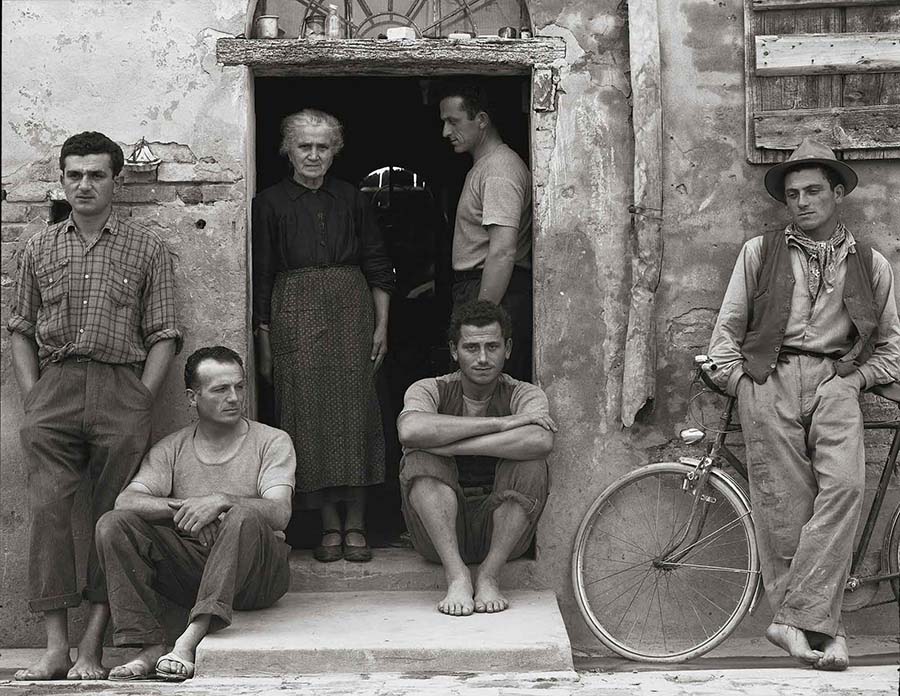
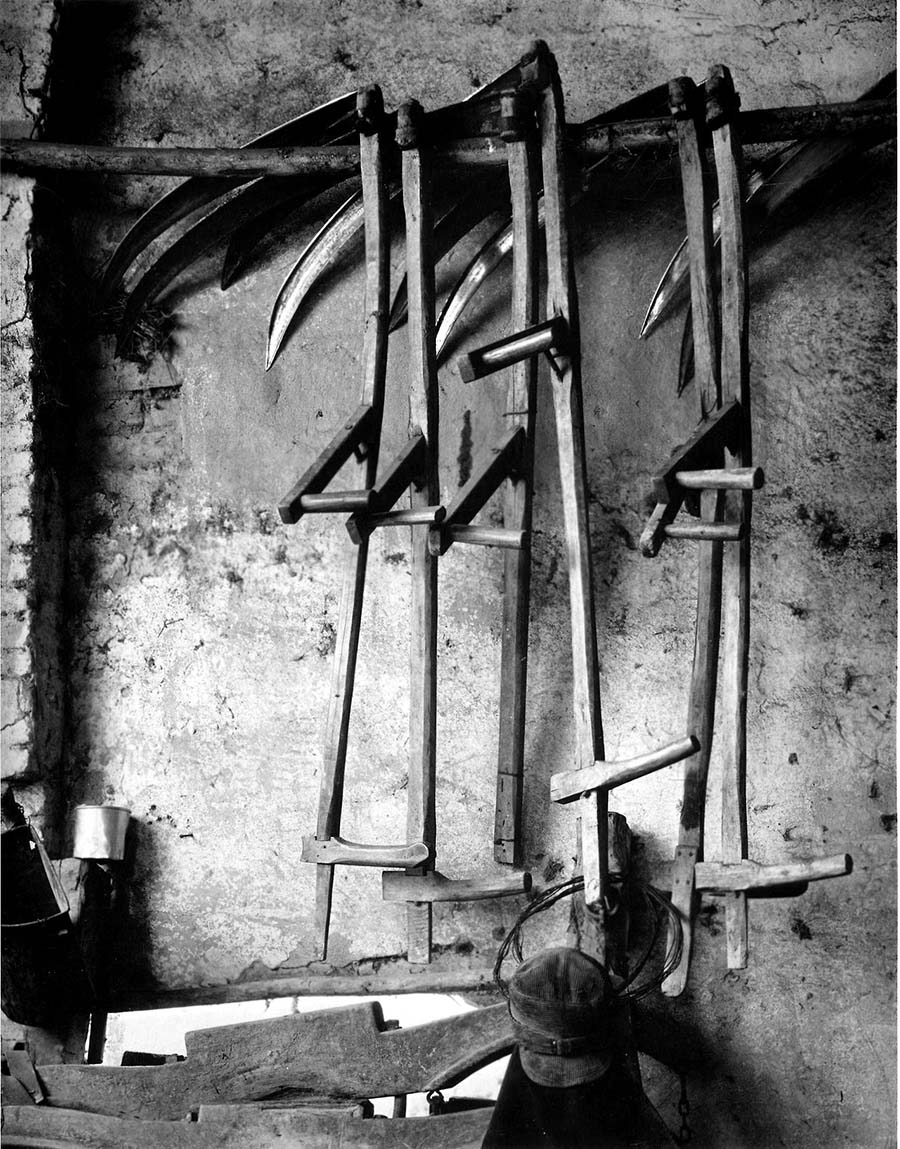
The following year Strand meets Zavattini, an Italian writer, in Perugia, Italy, and they decide to work together on a book about an Italian town, Luzzara in the Po Valley, and the writer’s birthplace. Strand spent two months in Luzzara taking photographs, collecting his impressions, five weeks in the spring and three in the fall. It portrays the local people, in addition to their homes, the landscape. The book with photographs of Strand and text by Zavattini is titled “Un Paese”. Later in 1954 he will repeat this work on a town, its people, houses, with the population of the island of South Uist, on the west coast of Scotland, where he will travel for three months with his wife. The book he makes, “Tir a´Mhurain”, also reflects the complicity of its inhabitants with the nature that occurs in this wild terrain. In fact, everywhere Strand photographs: Egypt, whose book “Living Egypt” is published in 1969, Morocco, Ghana, whose book ends in 1976, the year of his death, and Romania, Strand seeks out flat people, evades crowds and cities. Photograph people in their homes with natural light without tricks or effects, and naturally, without telling them how to position themselves. Strand says:
“I like to photograph people with strength and dignity on their faces, as much as life has mistreated them, they don’t fall apart.”
Some of his Photos
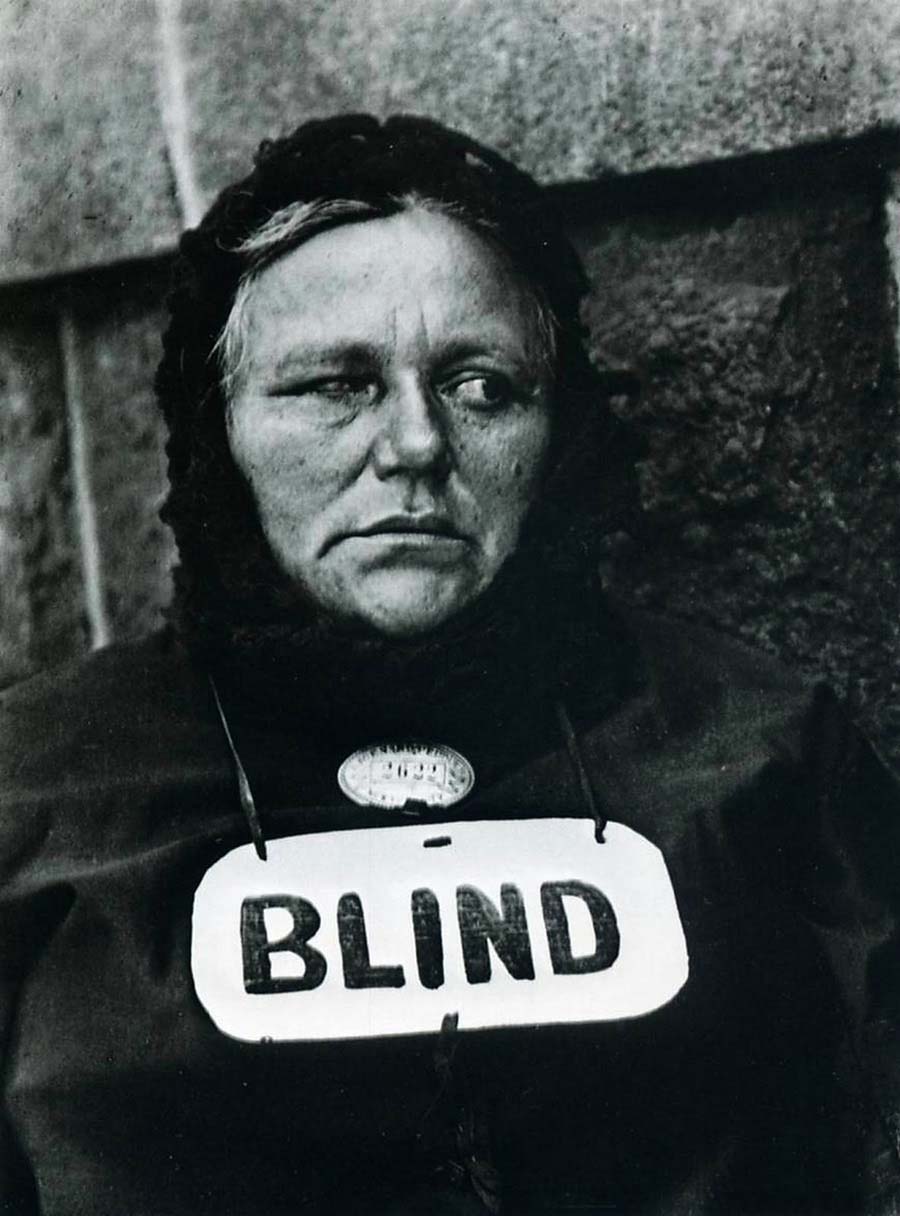
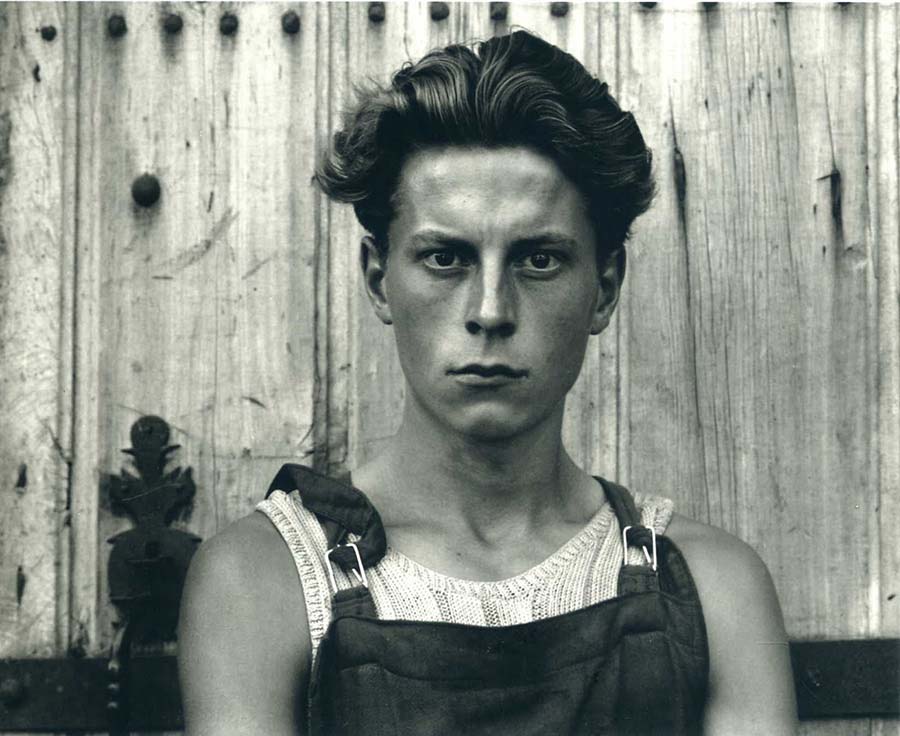

You might also like