(13 de septiembre de 1960, Johannesburgo, Sudáfrica – 27 de julio de 1994, Johannesburgo, Sudáfrica)
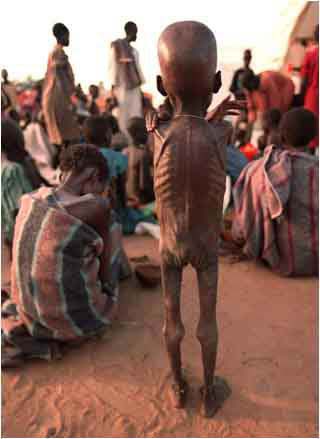
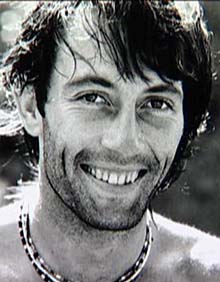 Kevin Carter was a South African photojournalist, member of the Bang-Bang Club , who won a Pulitzer in 1994 for photographing a starving Sudanese boy with a vulture behind him.
He began his career at age 23 (1983), when peripheral populations such as Soweto – near Johannesburg – were at war. There, being a member of The Johannesburg Star, he photographed expectant civilians to the situation they were living.
The picture that change his life
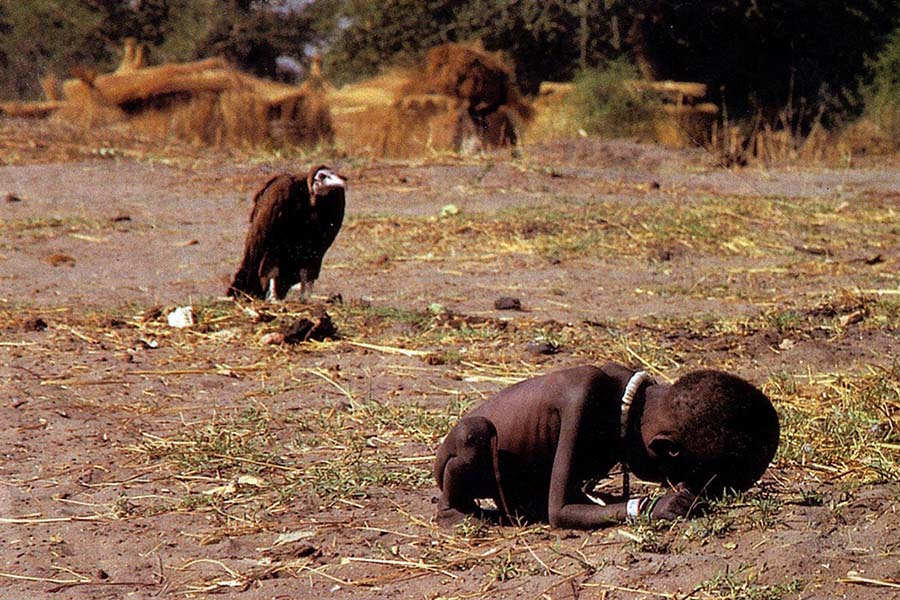
If Carter is famous, it is for a photograph that he made ten years later: in 1993, the Sudanese Kong Nyong, at that time a famished child, was defecating outside his village and a vulture was on the lookout. Carter, who watched the scene, photographed it. He waited to take a better picture: with the vulture opening its wings, but it did not work. According to him, he managed to recover and continue on his way. On March 26, 1993, The New York Times published the photo and he won the Pulitzer. Public opinion understood the photo as an allegory of what was happening in Sudan: Kong was the problem of hunger and poverty, the vulture was capitalism and Carter was the indifference of the rest of society. Criticism hovered against him and he tried to justify himself, alleging that the boy was making his needs, that the tribe was about 20 meters away from her and that the animal was waiting for their food ration. Kong Nyong died of a fever – mentioned by his father – in 2007.
Suicidio
After that, he went from reporter to nature photographer. He suffered two hard blows: on the one hand, the pressure of the criticism and on the other the murder of his friend Ken Oosterbroek on April 18, 1994, while covering a shooting in Tokoza, Johannesburg. It is said that years before he tried to commit suicide, that he smoked a white pipe – a mixture of marijuana, methaqualone and barbiturates – that he had serious family problems and a somewhat disordered personality – he was losing his reels in airplanes and airports – that he was depressed and had a life chaotic, with endless tragic experiences.
On July 27, 1994, Carter arrived at the river of Braamfontein Spruit, near the camp and the center of studies, an area where he played as a child and committed suicide. After immersing himself in the river, he sucked carbon monoxide through a hose stuck with tape. Exhaust pipe of your truck. Finally, he died of carbon monoxide poisoning at 33 years old. You can read something of his suicide note:
“I’m depressed […] without a telephone […] money for rent […] money for the maintenance of children […] money for debts […] money! !! […] I am tormented by the vivid memories of the killings and the corpses and the anger and pain […] of dying of hunger or hurt children, of the crazy of the easy trigger, often of the police, of the murderers executioners […] I’ve gone to join with Ken, if I’m lucky. ” (KC)
Alternative history about the photography
The South African photojournalist João Silva, who accompanied Carter to Sudan, gave a different version of the facts in an interview with the writer and journalist Akio Fujiwara, which the Japanese published in his book Ehagaki ni sareta shōnen -The boy who became Postal-.
According to Silva, he and Carter traveled to Sudan with the United Nations and landed in southern Sudan on March 11, 1993. United Nations staff told them they would take off again in about 30 minutes, the time needed to distribute the food, so they wandered to take some pictures. The United Nations began distributing corn and the village women left their wooden huts for the plane. Silva went to look for guerillas, while Carter did not go away more than a few meters from the plane.
According to Silva, Carter was quite surprised, since it was the first time he saw a real situation of famine, so he took many pictures of hungry children. Silva also started taking pictures of children on the floor, like crying, which were not published. The parents of the children were busy picking up the food from the plane, so they had neglected the children for now. This was the situation of the child in the photo made by Carter. A vulture landed behind. To put them both in box, Carter approached very slowly so as not to scare the vulture, and made the photo from about 10 meters. He made some more shots and the vulture left.
Two Spanish photographers who were in the same area at that time, José María Arenzana and Luis Davilla, without knowing the photograph of Kevin Carter, took a picture in a very similar situation. According to they narrated in several occasions, it was a center of feeding, and the vultures went by the rubbish of a dunghill.
They took him and Pepe Arenzana to Ayod, where they were almost all the time in a feeding center where people from the area go. At one end of the site, there was a dunghill where the waste was thrown and the people went to defecate. Because these children are so weak and malnourished, their heads go away giving the impression that they are dead. As part of the fauna there are vultures that go for those remains. That is why, if you take a telephoto lens, you squish the perspective with the child in the foreground and in the background the vultures and it seems that they are going to eat it, but that is an absolute hoax, maybe the animal is 20 meters away.
The death that was not
No one saw that baby die and it is the image itself that belies that tragic destiny, at least in part, since the creature in the photo has in its right hand a plastic bracelet from the food station of the Organization for Nations United (UN). Carter was criticized for not helping the baby and the world gave him up for dead even though Carter himself did not see him die, he just shot the photo and left. 18 years later, in 2011, a team of journalists traveled to the place and managed to confirm that the child survived the famine but died five years ago of “fevers”. His name was Kong Nyong.
Links
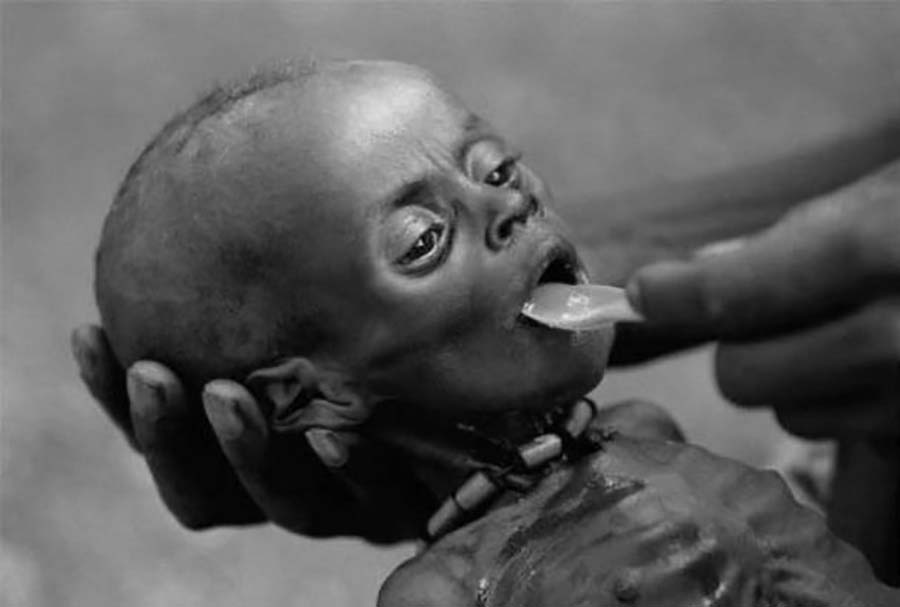
Some of his pictures

You might also like